









By Boak Ferris, WPH Certified Coach
WPH Press, 11/13/26
1A) Think like Chapman. He knew his opponent: what the opponent was really good at, and what he hated most. He made a game plan for just that opponent. On every shot, every serve, make him work a weakness. Chapman first proved this against Bike, a lefty, indomitable at waist-height and fast to recover center. Chapman sent him lobs and paced ceiling balls to his right hand, from anywhere on the court. (So? Drill your specific-opponent-frustrating shots from every court position; move your drill spot around, and drill that for each expected anticipated opponent you will face. Notice your drills and shot-selections change for each opponent, so you will want dedicated drills for each opponent one at a time.)
Chapman habitually returned to center, faked a paddle or shovel kill to draw Bike racing in, then sent a higher-percentage bounce-pass close to the wall, bouncing and scooting to the backwall. He exploited Bike’s superior speed to wear him out with his own strength. David did this to adult competitors by age 12. He also had his nonpareil backwall rollout, with several versions, for when Bike overhit. Even if Bike dug it, David would consciously redirect the dig to the ceiling or as bounce-passes along the walls, especially up the weak side wall, and into back right corner. TGO said, “Bike! Go get that one! You got it! Great! Here comes the ceiling! Run, Bike, run!”
Notice David’s directive thinking. Not “What do I do? What’s he doing to me?” His intent was to puppeteer. He never assumed a rally was over; he actually respected his opponents, by recognizing and acknowledging their strengths, and then refusing to feed those. But he knew a good game plan could beat them. “KISS, keep it simple sweetheart: hit everything to his off hand, until he sets you up.” Every shot should serve your game plan—even if a safer shot sets up the next one. Do NOT donate free points when receiving serve: make him execute from the toughest place you can send him.
1B) Your next opponent keeps you calm! Know who is next up in your tourney, write down your game plan, and visualize it thoroughly. Keep a reminder-page in your tournament bag for just that match. Soft shots are as good as hard if they reach opponents’ weaknesses, and if the opponent cannot do anything great with it. Replace hitting reflexive shots: instead, approach each shot with a single offensive or defensive purpose. This game plan becomes your “calm.” Also, notice, to accomplish this, you will need to be fit: Chapman could make others’ speed a liability because he built his own sustained efforts with VO₂ training. Improve your VO₂ max with appropriate intervallic training.
2) Adapt to the body you bring to each match. Your hopes and expectations are irrelevant. You can only do what your body allows that day. If timing, movement, or concentration misfires, stay calm: Respect: “Body isn’t doing this today; find a workaround.” Minor stiffness or an unreliable movement may call for different shot selections, less ambitious positioning, or more dependable punches, paddles, blocks, jabs, and lobs. Reassert command through calm, cyclic breathing: inhale during shot preparations and movements to the pre-shoot positions, and exhale continuously through execution of the entire shot. Never hold your breath. Return to the game plan; use a timeout and your notes when needed. Sometimes, correct breathing is all you require to return your body to its customary sensations.
3A) Be the calm center. Instead of needing, hoping, or wanting to win, enter the court and the match with this following attitude: “I am the calm center of the storm. I am here to execute, listen, learn, and apply, and execute—in that order.” As you fall asleep at bedtime, exhale slowly and visualize yourself moving to center court: “The opponent is caught in the winds around me.” Consciously, deliberately, and mindfully rehearse the calm you intend to bring into competition. I was in Fresno once when David attended the California State Championships. He asked Coach Lew, “I’m facing Tati in the Finals. I need reminders.” Lew said, “Your opponent is in your hurricane. Stay in the center, and help him rush around. Opponents need your help, and will accommodate. . . .You simply direct.”
3B) Listen! When things don’t work (in your latest match), go into your next drill modes, and rehearse anticipated tournament situations in your drills: “I’m receiving serve, down 19–16. What do I return to THIS one specific opponent?” The best internal command is “Listen!” Listen to your performance. What cost you/earned you that point? By “listen,” I mean hear what the last rally taught you, what did you try that did or did not work? Did you hear that? That sounded right/wrong! Do more, or do no more, of that! Change or duplicate your return, your pace, your angle, the angle of your body at setup—replace “playing” all off-key-notes—with singing exactly the right notes for this song.
Also, listen to your opponent’s points and his errors, and frustrations too” What? I heard that! The opponent cannot return the ball today at the off-hand shoulder? The opponent can’t move forward and back fast enough? Time to sing my song! It sounds like a hurricane! But I feel calm. I am centered. I know where all the next balls go. Such vigilant hearing transforms into directed execution and orchestration.
LISTEN: DO, WAH, DO! ♫♫♫♫
Boak Ferris Bio
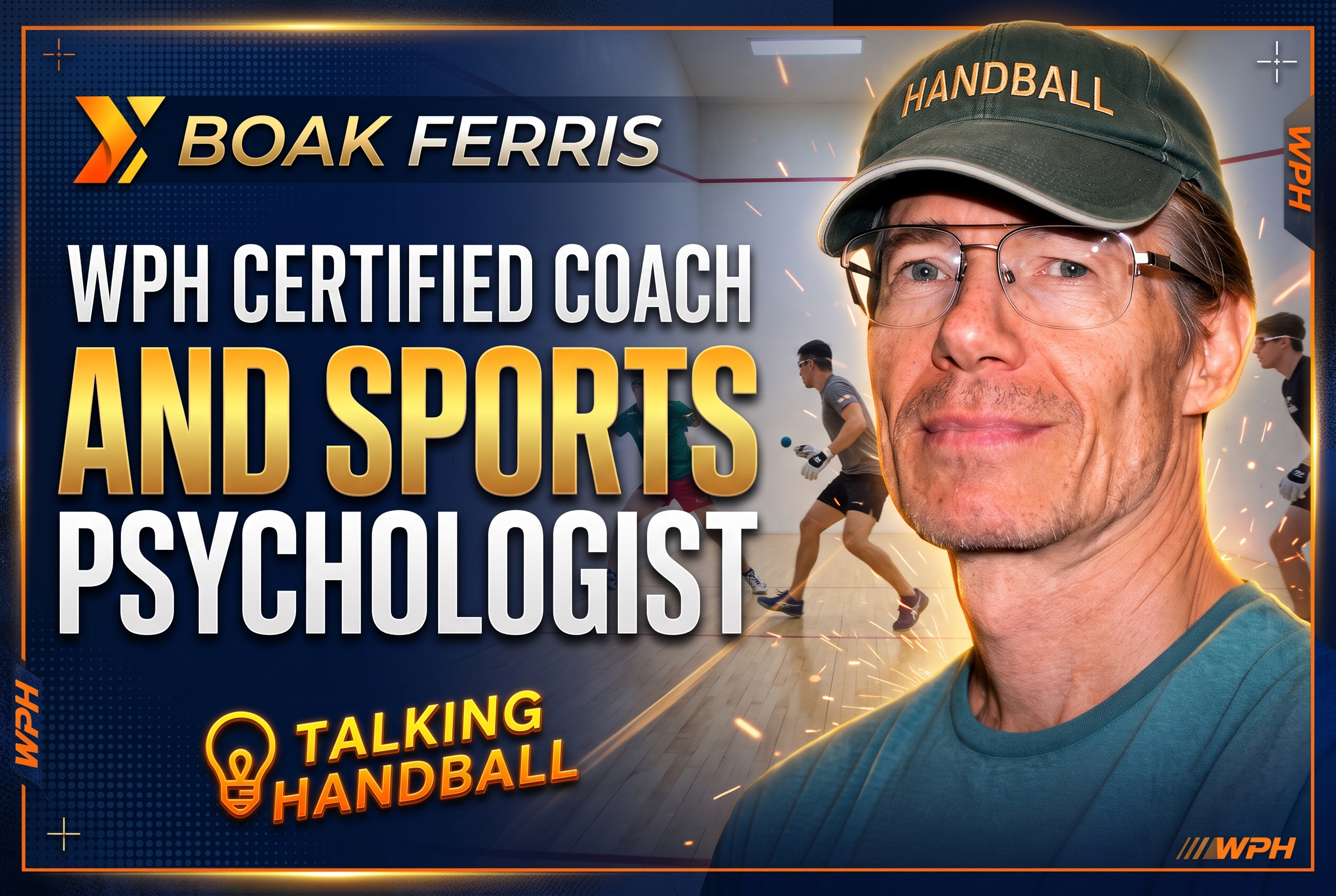
Boak is a top-tier, certified WPH handball coach and published researcher in sports-psychology, diet, biomechanics, and human neurodevelopment. Originally recruited as a faculty mentor into CSULB’s TEAMWIN Project to help university athletes excel in sports and academics, he coached members of the university’s tennis, water-polo, baseball, basketball, softball, golf, and volleyball teams. In 1992, Boak joined David Chapman’s team as first, part of the entourage, and later, as a bona-fide coach. He traveled with David’s team until about the year 2000. Today, Boak has twelve handball clients, of all experience levels, ranging from 16 up to 70 years of age. Some of these are distance learners, and others are onsite at his local clubs. Boak welcomes questions and coaches free of charge.