










WPH Press, 9/13/26
Written by JR WPH Coach Ciana Ni Churraoin
JR WPH Welcomes Coach Ciana HERE
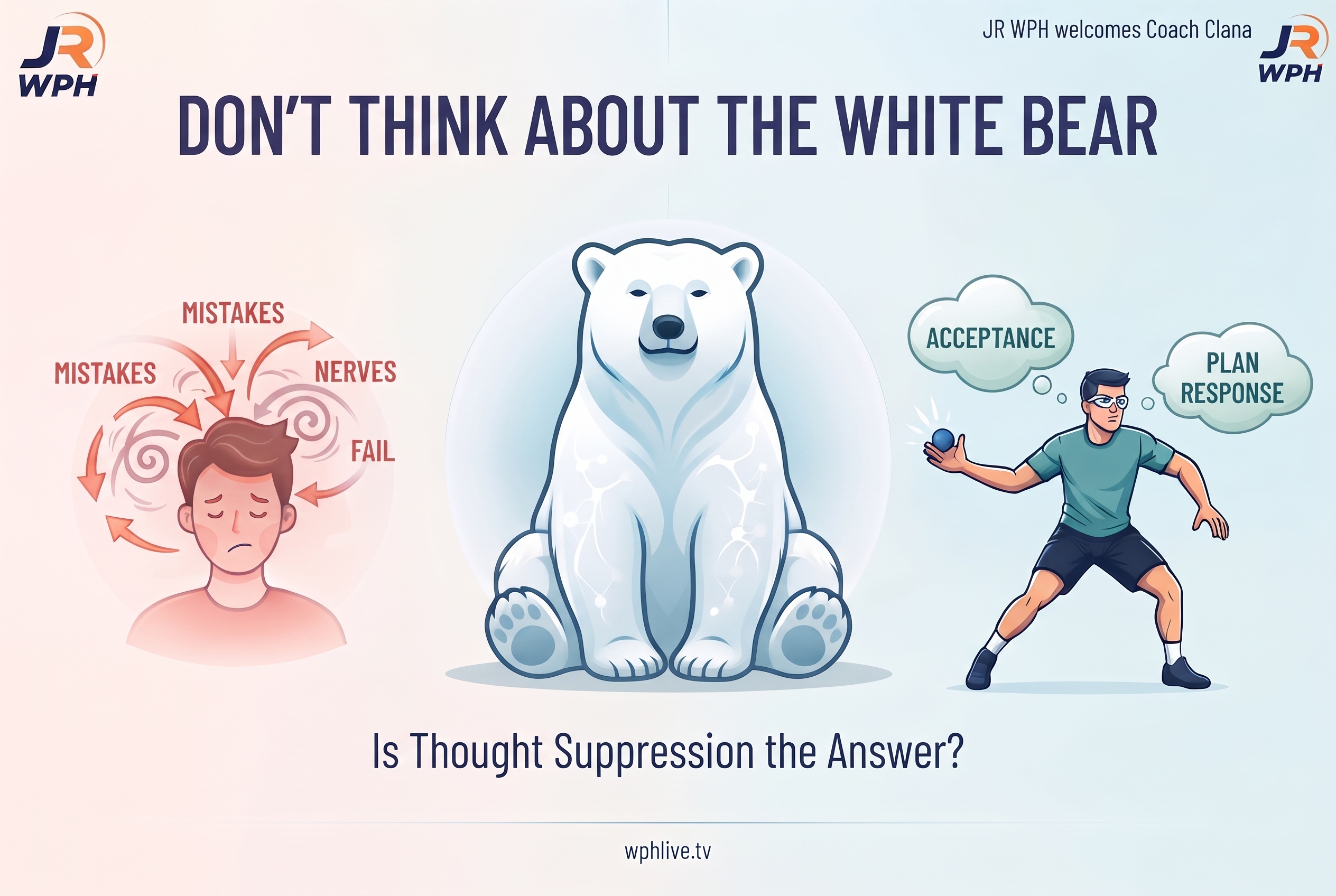
A lot of the time if we don’t like a thought, we try to avoid them, change them, and make them go away. And we often, perhaps without knowing, encourage others to do the same.
Here are some examples:
- Don’t think about making mistakes
- Don’t think about how nervous you are
- Don’t think about failing the exam
- Don’t think about how bad this could go
Before we go on I would like you to try this simple activity: I want you to start a timer for 1 minute, close your eyes, and don’t think about ANYTHING. Shut your mind off. No thoughts.
How did that go? Were you able to think about absolutely nothing?
Let’s do that again. Now I want you to turn on the timer, close your eyes, and as soon as you have a thought I want you to open your eyes and see how much time has passed.
How long did it take? Two seconds? Four? Ten?
This simple activity highlights that it is very hard to control our thoughts or to think about nothing. Even when we tell ourselves “think about nothing”, we are thinking about something. The same way the waterfall keeps flowing, thoughts are endless.
Similar to that waterfall, it is impossible to control what types of thoughts surface and how they will impact us. Some are helpful and some are unhelpful to us.
Let’s talk about thought suppression.
There are a lot of reasons why we try to suppress or change certain thoughts. They can feel uncomfortable and we might think that certain thoughts are problems if they appear and that we will perform worse because of them. Therefore we don’t want them and try to get rid of them when they appear. For example: many people associate nerves with something negative, so they may say “don’t be nervous” or they may associate planning for mistakes with an increased chance of making mistakes, so they say “don’t worry about mistakes”. Our mind and body is built to protect us, so we try to block out / avoid certain things to do so.
Not only is avoiding / blocking out certain thoughts very difficult to do successfully, it can also prove to do the opposite of what you actually intend.
In 1987, psychologist Daniel Wegner et al. published the famous White Bear Study. In this study, he examined thought suppression by asking his participants to think about anything but a white bear.
Very few people were successful at suppressing the thought of the White Bear.
Not only did most people struggle to block out the white bear but the ones who felt they were successful later experienced a REBOUND EFFECT. Meaning, they had many more thoughts about a white bear and those thoughts felt much stronger compared to the people who had struggled to block out the white bear in the first place.
This study actually found that suppressing the thought had the opposite effect of what was intended. It actually made participants think about the white bear MORE.
Think about that for a second. How often do you tell yourself to not think about something? Are you able to not think about it? Have you ever experienced something similar to the white bear study?
Going back to the examples at the start. There is nothing wrong with thinking about making a mistake, being nervous, failing an exam, or being worried how things will go. It is normal to have these thoughts. It’s what makes us human. These very thoughts can actually help us prepare and handle the adversity that may lie ahead.
It’s thinking that we shouldn’t be thinking these thoughts that can be problematic. Most of the time, it’s not the actual thought that’s impacted us, it’s our response and understanding of the thought that we are experiencing.
If you think about the white bear study, it’s the people who were unable to suppress the white bear that didn’t think about it in the long-run. They did not experience the rebound effect. They had a thought, accepted that it was there, and after the study, they moved on.
So what can you do with this information?
Instead of trying to avoid a thought, remind yourself that a thought is just a thought, thoughts are not always true and that you can choose how you respond to it.
As a coach, allow your players to have all their experiences. They do not need to think in a specific way. They may even benefit more from knowing there is nothing wrong with thinking a certain way. It is what they do with those thoughts that really matters.
Let’s look at how two different coaches handle the same situation:
Player A & Coach A:
– Player A: What if I make the same mistake I did in the last game?
– Coach A: Don’t worry about mistakes until they happen
– Player A: Okay…
Player B & Coach B:
– Player B: What if I make the same mistake I did in the last game?
– Coach B: That’s ok. You might. And you also know how to respond to mistakes. How will you do that?
– Player A: If I make the same mistake, I will take a deep breath, remind myself that mistakes are a part of the game, and focus on returning the serve.
I think we can all agree that Player B & Coach B handled the situation more effectively. Instead of avoiding, telling them to deal with it when it happens, and maybe causing more concern, we come up with a working solution.
So next time, you find yourself trying to avoid certain thoughts / emotions, or encourage someone else to do the same, take a second, and consider: How can I respond to this more effectively? How can I help this player with this concern / thought?
JR WPH Coaches HERE
JR WPH would love to have you join our team. If you are interested in joining Team JR WPH as a coach, please contact JR WPH Director David Fink at David.fink@wphlive.tv
Keep an eye out on juniorhandball.org, as new clinic opportunities and recaps pop up weekly. Want to coach a clinic or a junior handball program? Need more information regarding junior handball? The Junior WPH group spans multiple countries, continents and oceans with clinics happening daily. We can help! Contact WPH Development Director David Fink at david.fink@wphlive.tv
To enable Junior WPH to continue to host junior handball clinics and tournaments across North America with Certified WPH Coaches, the World Players of Handball invites you to make a tax-deductible donation today in supporting the growth of the game. 100% of the donations received by the WPH go towards junior handball development. Donate on-line HERE or send your generous gifts through PayPal (HERE) or by mailing checks to: WPH, 3602 E. Ft. Lowell Rd., Tucson, AZ 85716
Become a handball insider by enjoying never before seen videos, pro commentary, special awards, Sports Casts archives and new episodes, live broadcasts, and much more by supporting the WPH and inspiring the next generation of players through the WPH Patreon program.
Become a WPH Patreon HERE