









Footwork, Quiet Eye, and Proprioception Integrate to Generate Shot-Options
Introduction
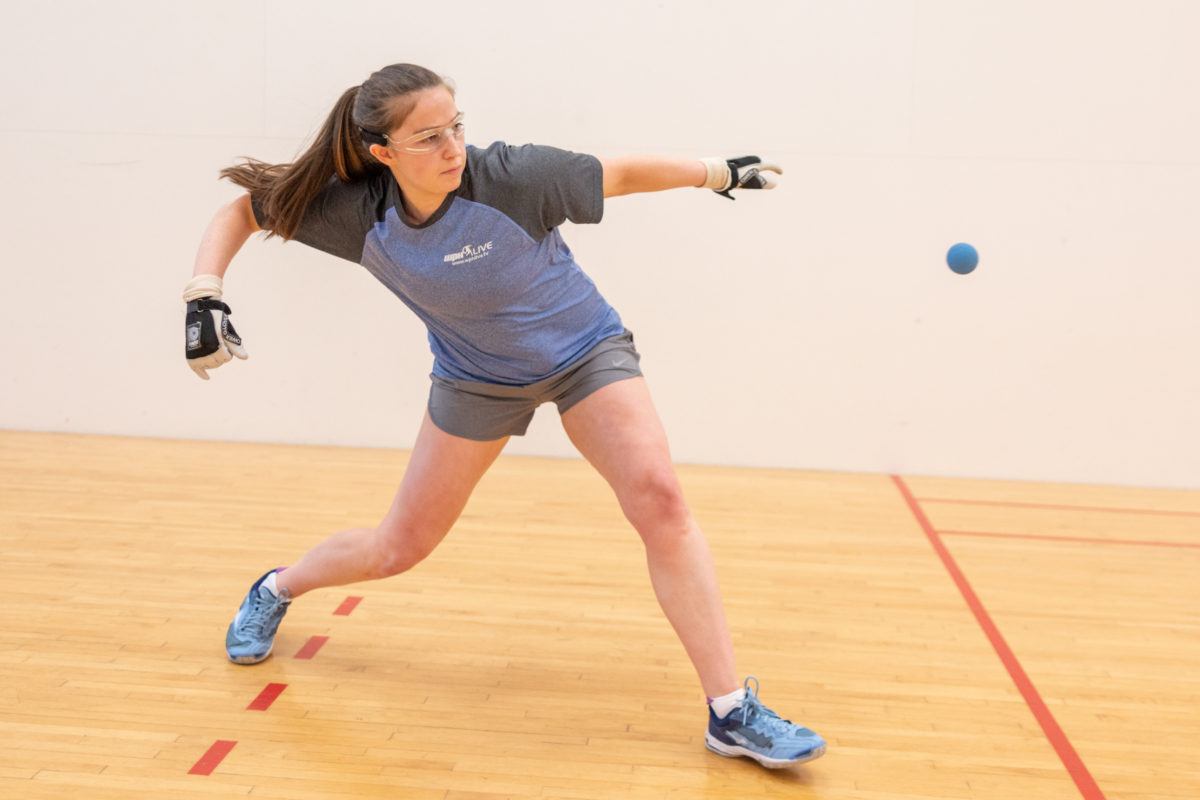
The accompanying photograph of elite four-wall handball champion Catriona Casey captures far more than an athletic moment. It freezes an instant in which biomechanics, perception, anticipation, and decision-making converge. Where trophy-poses like these fail viewers involves how such images do not show what the competitor had to do prior to moving into the “pose.” They also do not show what the experienced competitor must do after ball contact, to recover a dominant position in the court, a position which her shot-selection options are prioritized to achieve.
Here, what appears to be a single stroke is actually a visible cross-section of an integrated sequential system, an artificial snapshot taken during a moment in an unfolding process in a 4D phase-state: This “4D” state includes the court’s height-length-width with Time, combining her knowledge of the 3D environment, and her awareness of multiple time elements, such as the oncoming flight of the ball, her position, and that of her opponent. Elite players do not simply strike the ball well—they preserve the greatest possible number of tactical options until the last instant before contact.
Ground-Up Biomechanics
Her easy power begins on the ground rather than at the hand, starting with practiced footwork into the ball. Her obvious rear-foot turn-over, signaled by her rear toe on the floor, with her rear heel lifting up, releases her rear hip: next, the perceived “rear hip,” rotates, (though it is really her whole hip-girdle rotating), the torso follows, and the arm becomes the final whip into the ball for striking the ball. The non-hitting arm stays—must stay—elevated, to counterbalance the lower-body lag, to delay premature shoulder-opening, and to contribute to efficient rotational sequencing. Casey’s lead foot is still completing its placement, signaled by the front toe still off the ground, as the heel plants, much as a baseball batter’s, as her kinetic chain uncoils for impact, allowing her weight transfer and momentum to be conducted through the ball at finish. If you drill, you need to be placing your front heel or front ball of your foot down, prior to contact.
The Quiet Head and Quiet Eye
Her remarkably steady head permits a stable visual field, where the ball is not bobbling, nor blurry, nor indistinct, but rather frozen in time. Such elite eye-discipline has found science, these days, and is called by experts the “Quiet Eye,” which means not merely watching the ball. An elite player fixes her attention upon a very precise, intended contact-spot on the ball. She has contact-spot options on the ball, that she can elect to meet with her palm or fingers. A possible sidearmed contact point below the ball’s equator will permit lift; a sidearmed contact point outside the equator, relative to her POV, will allow her to pull the ball left for a pass; while an underarm-directed contact underneath the ball’s equator can send the ball up the right. Also, consider how either sidearmed or underarmed hand-contact above the ball’s equator, with the palm finishing over the top, can bring the ball sharply downward for a kill or for an unexpectedly low passing shot. The dominant competitor is not looking at the sphere, as an amateur or spectator would; the competitor is selecting optional geometrical points on the ball itself, each of which represents a trajectory for the struck ball, AND also represents a precise front-wall spot, court-space, sidewall spot, or floorboard in the court to which to send the ball.
Preserving Optionality: 100 % Four-Way Shot-making
The line from the rear toe through the lead foot suggests only an initial attacking posture or gesture: that line does not necessarily dictate the ball’s eventual destination. High elbows, balanced posture, delayed shoulder opening, and efficient sequencing preserve multiple options for directing the rallies. Because her final commitment is delayed, lagged, perhaps, the opponent will try to predict reliable information, and end up a bit too late to react comfortably. Great mechanics, therefore, prefigure and generate both power and deception.
Dynamic Court Mapping
Elite performance extends beyond these discussed biomechanics. Experienced players continuously integrate proprioception, peripheral vision, hearing, memory, timing, and awareness of their own body positions into evolving internal models of the court. While their visual fixation remains on the intended contact spot, the championship competitor simultaneously maintains awareness of the opponent’s likely movement, of the court geometry, and of the best developing tactical opportunities. The resulting decisions appear instinctive only because thousands of repetitions have refined this multisensory model. What this means in practice, for intended champions, is drilling every single time with a persistent opponent and match situation in your mind, and moving into the ball, before striking, while drilling, and moving to your center domination position after striking, while drilling. When you are drilling, solo or with a coach, you need constant mental visualizations: “It is five serving six in the tiebreaker, I am on defense/offense, striking this ball which I have moved into, during this drill.” One way you can learn involves finding videos of champions who share your body-size and type, and watching them during a championship match. But watching only them, and watching just their movements away from the ball and away from the other competitor. Naturally, if you get distracted by watching the ball in the video, or the opponent, you will miss the hard work and discipline that your champion exhibits.
Coaching Implications
Coaches should teach movement patterns during drills that preserve tactical choices during imagined competitions, instead of simplistically teaching players to “acquire” each stroke, one by one. Drills should reinforce the quiet head, efficient lower-body sequencing, disciplined visual fixation, balanced posture, and accurate and optional contact points. Tactical awareness should evolve simultaneously alongside technical proficiency through exercises that encourage players to integrate hearing, proprioception, peripheral information, match-visualization, and anticipation into every shot as if in live rallies.
Conclusion
Dominating elite handball is not simply about the generation of force. It is about constantly generating and maintaining proper footwork: It is the management of information, geometry, timing, and movement. Efficient preliminary footwork allows the competitor to arrive at contact in balance—with options. Maintaining a Quiet Eye allows precise control of contact geometry; with the other senses practiced and active. The Quiet Eye also allows for dynamic court-mapping which will inform the final tactical choice. Integrated by practice with mindful drills, these elements preserve multiple options until the ball-contact, allowing the accomplished competitor to strike with efficiency and unpredictability, and with court-domain domination.
Disclaimer Including Biomechanical and Verbal Internalized Scripts
Please note that athletes and readers of articles often ask, “Can’t you demonstrate these tips in a video-instructional or tutorial?” Or can’t I learn this from AI? I would counter-suggest that biomechanics begin with “verbal” scripts, not necessarily with gestural imitation. Once you say, “I have to take three steps into the ball, and strike it after I place my front foot down,” you can next internalize it into a musculoskeletal habit: a “biomechanical script.” Your brain and body will next economize this over time, and it will become “muscle-memory.” So, as a wordsmith and coach, I would argue that the right language leads to the right motions. When you next watch your champion, you will have “scripts to test.”
Boak Ferris Bio
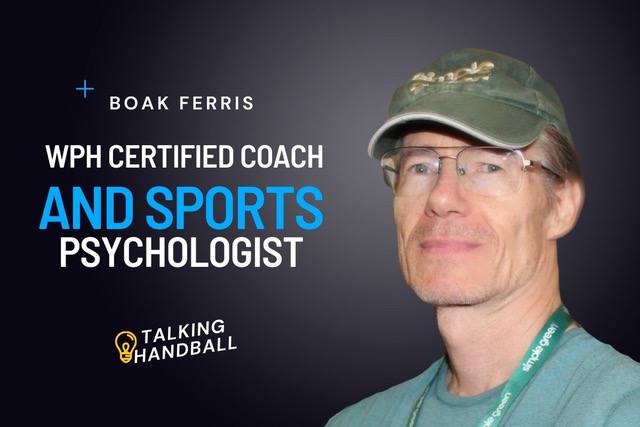
Boak is a top-tier, certified WPH handball coach and published researcher in sports-psychology, diet, biomechanics, and human neurodevelopment. Originally recruited as a faculty mentor into CSULB’s TEAMWIN Project to help university athletes excel in sports and academics, he coached members of the university’s tennis, water-polo, baseball, basketball, softball, golf, and volleyball teams. In 1992, Boak joined David Chapman’s team as first, part of the entourage, and later, as a bona-fide coach. He traveled with David’s team until about the year 2000. Today, Boak has twelve handball clients, of all experience levels, ranging from 16 up to 70 years of age. Some of these are distance learners, and others are onsite at his local clubs. Boak welcomes questions and coaches free of charge.